


Table of Contents
Here's a situation most SEOs have been in but few talk about honestly.
You publish a piece. It does well. It earns its position in the top five, gets cited a few times, maybe picks up some backlinks. You don't touch it for a year because it's performing and there are new things to work on.
Then, gradually, it starts to slip. Position three becomes position seven. Position seven becomes twelve. You check the page for technical issues — nothing. You check your backlink profile — stable. You audit the content against its competitors — it's still longer, still better structured, still more thorough than most of what's ranking above it.
So what happened?
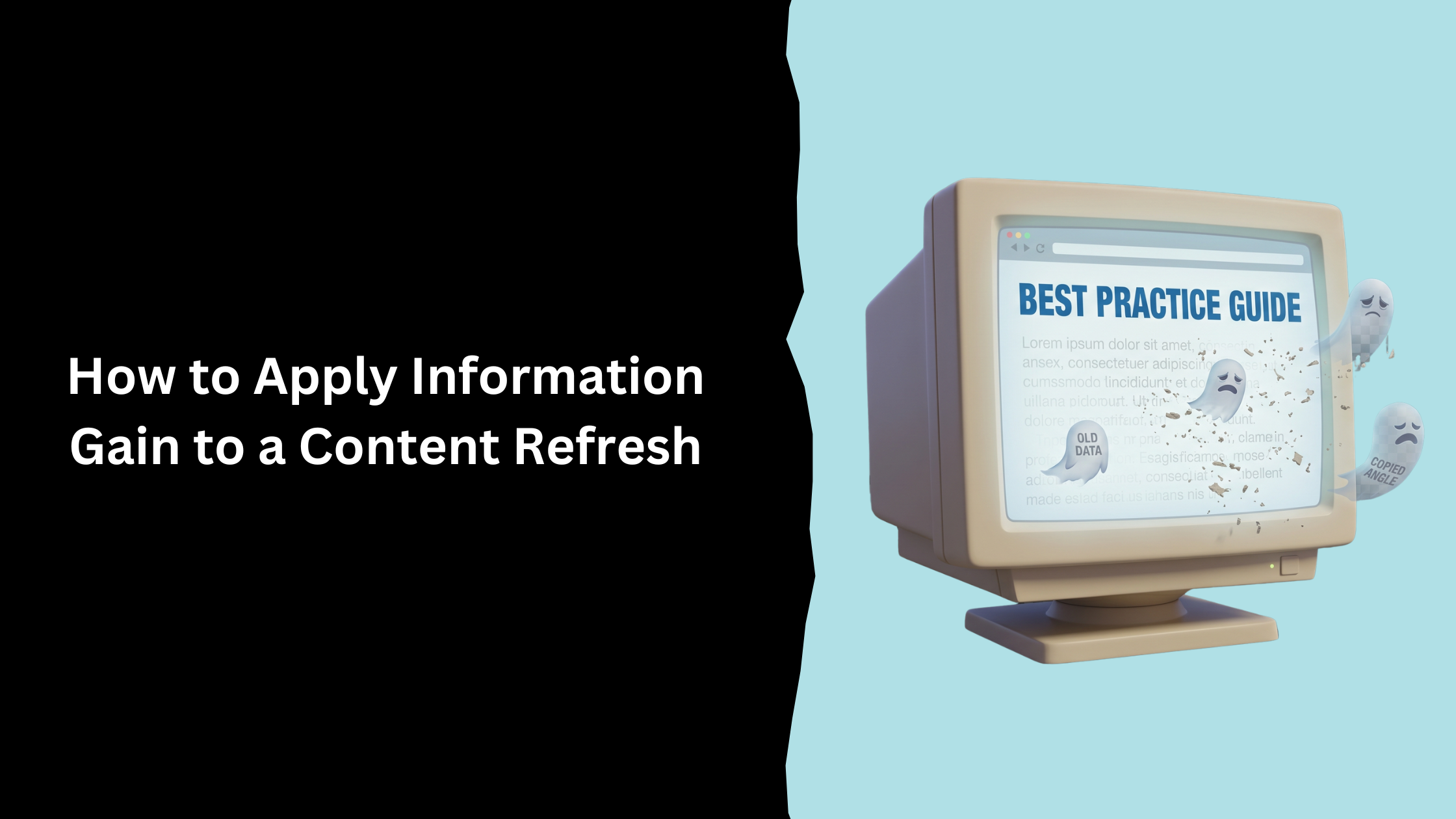
The answer, most of the time, is that the page experienced IG decay. Its information gain eroded. Not because the page got worse — because the SERP moved around it.
This is the piece about that: what IG decay actually is, how to diagnose it, and how to run a proper information gain refresh that goes well beyond updating statistics and republishing with today's date.
The Problem Nobody Names: IG Decay
What IG Decay Actually Means
Information gain decay is what happens when content that was once unique becomes consensus content through no fault of its own.
When you first publish something, you map the SERP, identify what's missing, add it, and ship. At that moment, your content has genuine differentiation — it covers angles, makes claims, or provides evidence that the rest of the results don't. That's your information gain.
The problem is the SERP doesn't stay still.
Competitors read your piece and write their own versions. The angles you covered get absorbed into their articles. New entrants to the SERP do SERP research — which means they read your page too — and reproduce your best points. A year later, the things that made your content unique are now standard across the top ten. You haven't changed a word, but your information gain has collapsed.
The page is now consensus content. It's making the same claims, covering the same angles, and providing the same evidence as everything else. Google can satisfy a user who wants this information with any number of results — and you start losing position to ones with fresher signals, stronger domain authority, or more recent publish dates.
This is different from the kind of ranking drop caused by a technical issue or a lost backlink. It's a content-layer problem, and it needs a content-layer fix. But it also needs a specific kind of fix — one that targets the IG problem, not just the freshness signal.
That distinction matters a lot, and most content refresh advice gets it wrong.
The Four Signals That Tell You IG Decay Has Set In
Most advice on when to refresh content is vague: "when rankings drop" or "every six months." That's not useful. Here are the specific patterns that indicate IG decay rather than a technical issue or link-based ranking shift.
Signal one: Rankings slipping with no apparent technical cause. Before attributing a ranking drop to IG decay, rule out the obvious. Has the page had crawl issues? Has it lost referring domains? Has there been a significant algorithm update that affected the whole site? If none of those explain the drop, look at content-layer causes next.
Signal two: Impressions increasing while CTR falls. This is the AI Overview footprint. Your page is being seen — GSC is registering impressions — but users aren't clicking through because Google's AI Overview is answering the query directly from existing results, yours included. What's happened is that your content is being consumed into the AI Overview synthesis rather than clicked on. For that to reverse, you need to provide something that makes the full page worth visiting.
Signal three: Your specific claims now appear in competitor articles. Go back to the points that originally made your content different. The specific data point, the process framework, the contrarian argument. Then search for those things. If they appear in other articles that weren't there when you published, your IG has been absorbed. This isn't plagiarism — it's just how information spreads. But it means your differentiation is gone.
Signal four: You're ranking alongside articles you used to rank above. Pull up the SERP for your target query and compare the articles you're now sharing page one with against the ones you were outranking when you first published. If articles that weren't in the top ten twelve months ago are now ranking alongside you — and they're newer, more comprehensive, or drawing on the same angles you pioneered — that's the absorption process in action.
Freshness Refresh vs. IG Refresh: Know Which Job You're Doing
This is the distinction the entire content refresh conversation collapses. Every article about refreshing content treats "update the stats," "add new information," and "republish" as if they're the same job with different levels of effort. They're not. They're two different jobs aimed at two different problems.
Getting clear on which one you're doing before you start changes everything.
What a Freshness Refresh Is (and Isn't)
A freshness refresh is maintenance work. It involves:
- Updating statistics and figures that have aged out
- Replacing references to tools, companies, or products that have changed
- Fixing broken links
- Adding a brief note on anything that's materially changed in the topic
- Updating the publish date
This work matters. Google's freshness signals are real — particularly for topics where users have a legitimate expectation that information is current. If your article on "content marketing costs" cites 2021 benchmark data, a freshness refresh that updates those figures to 2025 data will help.
But here's what a freshness refresh doesn't do: it doesn't recover lost information gain. If the angles your piece covers have been absorbed by competitors, swapping out an old statistic for a new one changes nothing about your differentiation problem. You're making the content more accurate, not more unique.
A lot of "content refresh" work that fails to move rankings fails for exactly this reason. The team updated the piece, republished it, and nothing happened — because the problem was IG decay and the solution was a freshness refresh. Wrong tool for the job.
What an IG Refresh Actually Involves
An IG refresh addresses the differentiation problem. It requires:
- Auditing which of your current claims and angles have been absorbed by the SERP
- Finding a new source of unique information to add
- Restructuring or cutting sections that are now redundant
- Potentially removing entire H2s that were once differentiated but no longer are
- Adding net-new entity coverage that doesn't exist elsewhere
An IG refresh takes longer and costs more than a freshness refresh. It also requires having something to add — a source of new information that isn't already in the SERP. Without that, you can't do a genuine IG refresh. You can only do a freshness refresh and hope for the best.
The other thing worth saying: not every content decline calls for a full IG refresh. Some pages can be recovered with a freshness refresh alone. The diagnosis comes first.
How to Decide Which One You Need
The quickest way to work this out is a claims audit on your own page.
Pick three to five of the most specific, original claims your content makes. Not the generic ones — the points that felt genuinely different when you first wrote them. Now search for each one.
If those claims appear in recent articles that weren't ranking when you published — not paraphrased, but substantively covered with similar or better evidence — your IG on those points has been absorbed. If they still don't appear elsewhere, your differentiation is intact.
Two or more absorbed claims across a page that's losing rankings: you need an IG refresh.
One absorbed claim or no absorbed claims but declining rankings: start with a freshness refresh and monitor. The issue may be elsewhere.

How to Run an IG Refresh: The Actual Process
Step 1 - Audit Your Own Page Before You Touch the SERP
This is the one that gets skipped most often, and it's probably the most important step.
The standard content refresh process goes: check the SERP, see what competitors are doing, identify what you're missing, add it. That sequence trains you to reproduce what currently ranks. You end up adding to your page the same things the competition has recently added to theirs. The net result is more consensus content on a page that already has a consensus content problem.
The IG refresh process starts somewhere different. It starts with your own page.
Before looking at a single competitor, go through every section of your current content and categorise each claim on a simple three-point scale:
Still unique — You've checked and this specific angle, evidence, or framing doesn't appear in the current top ten.
Partially absorbed — Other articles now cover this ground but your version is more specific, better evidenced, or more detailed.
Fully absorbed — Other articles cover this as well as or better than you do. Your version offers nothing additional.
Work through the whole page like this. Be honest. It's uncomfortable to look at a piece you're proud of and acknowledge that the best bits have been replicated, but that's the data you need.
When you're done, you have a map of what's still working and what isn't. That map tells you where to cut, where to reinforce, and where you need new material.

Step 2 - Map What's Been Absorbed
For every claim you've marked as fully absorbed, you need to make a decision: cut, compress, or re-differentiate.
Before making that decision, get specific about what happened. Who absorbed the angle? When did their article go live relative to yours? Is their treatment substantively better than yours, or just newer?
If their treatment is better — more evidence, more depth, more specific — you have two options: cut the section or go one level deeper. Going one level deeper doesn't mean writing more words about the same thing. It means finding a more specific angle within that section that the competition hasn't covered.
For example: say you wrote a piece about technical SEO for ecommerce sites that originally included a section on crawl budget that was genuinely differentiated — it covered crawl budget specifically for large-catalogue ecommerce sites with faceted navigation, which most technical SEO guides don't address. Twelve months later, three articles in the top ten now cover this specifically. Your section has been absorbed.
Going one level deeper might look like: narrowing the focus to crawl budget for sites using Shopify's automated collection URLs, which has specific behaviours that differ from the general faceted navigation problem. That's a level of specificity the competition hasn't reached yet. Whether you can write it depends on whether you have something to say about it — if you don't have the knowledge or evidence, the section needs to go.
Compress, don't always cut. Fully absorbed sections don't always need to be removed entirely. If the topic is expected to be covered by the page (it would look conspicuous by its absence), compress it to two or three sentences that acknowledge it and link elsewhere for detail. That way you're not gutting the page's coverage while also not padding it with redundant information.
Step 3 - Find Your New IG Source
You cannot do an IG refresh without a source. This sounds obvious but it gets overlooked constantly, because the temptation when refreshing content is to start writing rather than start sourcing.
The four real IG sources for a refresh are the same as for new content — but some are more accessible for refresh work than for new content, and some are harder.
New proprietary data. Has anything changed in your data since the original piece was published? If you're an agency, have you accumulated client results that speak to the topic? If you're a brand, has your product usage data grown or changed? New data is the strongest IG source for a refresh because it's not just different — it's also fresher, which addresses both the IG and the freshness problem simultaneously.
A fresh SME interview. Go back to whoever you interviewed for the original piece, or find someone new. The question isn't "what's changed about this topic" in the abstract — it's "what have you seen or learned in the last 12 months that you didn't know when we last spoke?" That framing gets you current, specific knowledge rather than a rehearsal of established positions.
A contrarian update. Has the consensus on this topic shifted? Has something you asserted in the original piece turned out to be wrong, or been challenged convincingly? Publishing an honest update — "we said X, here's what we've since learned" — is one of the most underused IG sources in content refreshes. It signals genuine expertise precisely because it shows you're monitoring the space rather than just publishing and moving on.
Deeper specificity on an angle you covered shallowly. Go back to your "partially absorbed" sections — the ones where your original coverage was substantively good but thin. Is there a version of that section that goes significantly deeper? If so, and if you have the material to fill it out, that's a legitimate IG source that doesn't require new data or a new interview. You're going to a level of specificity the competition hasn't reached.
The one thing that doesn't work: going back to the SERP, identifying what your competitors have added recently, and adding the same things. That's not an IG refresh. It's competitive parity work, and by the time you've done it, the competition is already moving on to the next thing.
Step 4 — Cut, Compress, or Re-Differentiate
Once you know what's been absorbed and what your new IG source is, you can start restructuring.
In practice, that often means a page gets shorter before it gets longer. You strip out the absorbed sections, compress the partially-absorbed ones, and then build out the new material. This runs counter to the instinct that longer pages perform better — but a 3,000-word page with 500 words of genuine IG and 2,500 words of consensus content is worse, from an IG standpoint, than a 2,000-word page with 1,500 words of genuinely differentiated content.
The compression note matters more than people think. When you remove or shrink a section, you're signalling to Google that this page is becoming more focused, not less valuable. The risk is only when you remove content that was independently earning traffic for the page — which brings us to the cannibalisation problem covered in the next section.
Step 5 - Republish With an Explicit Change Log
Most republished content gets a "last updated" date at the top and nothing else. That's better than nothing, but it doesn't communicate the nature of the change — whether it was a freshness refresh (minor) or a substantive IG refresh (significant).
Add a brief change log, either at the top of the piece or in a collapsible section. It doesn't need to be long — two to four sentences explaining what changed and why. Something like:
"Updated October 2025 — we've added a new section on [specific angle] based on data from [source], removed the section on [topic] as it's now covered in more depth in [linked piece], and updated the SME quotes throughout with a fresh interview."
It signals to crawlers that the change was substantive. It signals to readers (and therefore to engagement metrics) that the piece has been actively maintained. And it gives AI Overview systems explicit information about what's new and what's been removed — relevant as those systems increasingly factor content recency into citation decisions.
The change log also keeps you honest. If you can't write two sentences explaining what actually changed and why, it's worth asking whether a genuine IG refresh has happened or whether you've done a freshness pass and called it something more than it is.
The Cannibalisation Problem Nobody Warns You About
This is the part of IG refreshes that goes wrong most often, and it goes wrong because content teams don't check their GSC data before cutting sections.
When Stripping IG Sections Creates a Ranking Gap
Here's the scenario. Your article ranks primarily for its head term. It also — without you necessarily knowing about it — ranks for a cluster of long-tail queries that are being answered by specific sections within the piece. A section on a detailed sub-topic is pulling impressions for that sub-topic specifically, even though you never targeted it directly.
You go through the IG audit, identify that section as fully absorbed, and cut it. The head term ranking is unaffected. But the long-tail queries that section was answering disappear from your GSC data because the page no longer covers them.
If those queries are commercially meaningful — if they represent real users at a specific point in a research journey — you've created a gap in your coverage. The fix isn't to keep the section as-is. It's to check before you cut.
Pull your GSC data for the page and filter by query. Look for long-tail queries that the page is earning impressions for — even moderate ones, even ones where you're ranking position 15. Map those queries to the sections of your page. If a section you're planning to cut is the only reason the page ranks for certain queries, you have two options:
Keep the section compressed. Reduce it to enough coverage to maintain the ranking signal without reproducing consensus content at length. A focused paragraph that answers the query cleanly is enough.
Spin it out before you cut it. If the sub-topic has enough query volume to warrant its own page, publish a dedicated piece for it first. Then, when you cut the section from the original article, replace it with a brief mention and an internal link to the new piece. You preserve the coverage, improve the internal linking structure, and avoid the traffic gap.
The order matters: spin out first, cut second. If you cut first, the ranking gap exists while the new piece is being indexed and earning authority — which could take months.
When Your Refreshed Page Competes With a Newer Page
The other cannibalisation risk in IG refreshes is one that emerges from time passing between the original publish and the refresh.
If you've published new content in the same cluster since the original piece went live, your content map has changed. The refresh needs to account for that.
Work through the following before you republish:
Does the refreshed piece now cover ground that a newer page in the cluster also covers? If yes, decide which page owns each angle and adjust accordingly. The refreshed piece should not reproduce sections that a newer, more focused page handles better. Update the relevant section to a brief mention with an internal link.
Do the internal links in the refreshed piece still point to the right places? Cluster content published after the original piece might be a better destination for some of the anchors. Update them.
Does the original piece still make sense as the cluster hub, or has a newer piece taken over that role? If you published a more comprehensive, more recent piece on a related topic that's now outranking this one, consider whether the original piece should be redirected, consolidated, or restructured to play a supporting role rather than a competing one.
Mapping the cluster before you republish takes an hour and prevents weeks of confusion around mixed ranking signals.
What to Do When a High-DA Site Has Absorbed Your Angle
This happens. You publish something original and specific. Twelve months later, Backlinko or Ahrefs or HubSpot publishes the same angle — better resourced, with more examples, and backed by a domain with twenty times your authority. Your IG is gone.
The instinct is to go deeper. Write more. Add more evidence. Out-detail them. That's right in theory but incomplete in practice, because depth alone doesn't recover IG if the depth is covering the same ground.
Four realistic options:
Go to a more specific sub-angle. Don't try to beat them on the angle they've published. Find the angle within their angle that they haven't covered yet. Large publisher articles tend to be comprehensive but shallow — they cover the territory at a level of generality that serves the widest audience. There's almost always a sub-angle that's too specific or too narrow for their audience but is exactly right for yours. That's where you go.
Attack an adjacent angle they haven't found yet. If a major publisher has absorbed your original angle, they've also signalled what they think the topic's key sub-topics are. Look at what they didn't cover. The gaps in a comprehensive Backlinko article are often very deliberate — they represent territory that's too niche, too contested, or too operationally specific for their editorial model. Those gaps are openings.
Add a source they can't replicate. A large publisher can out-research and out-resource you on the things that can be found on the internet. They can't replicate your client data, your internal case studies, or your first-hand experience running campaigns. If you can inject that kind of material into your piece — specific, sourced, non-generic — you have something they don't. This is the strongest recovery path for agency and B2B content specifically.
Accept the loss and redirect energy. Sometimes the honest answer is that a high-DA competitor has published something that you cannot meaningfully improve on with your current resources. Rather than pouring effort into a refresh that won't recover the position, redirect to a gap they haven't found yet. The IG analysis that tells you what they covered also tells you what they haven't.
The one approach that doesn't work is writing a longer version of what they published. Word count isn't information gain. You can write 8,000 words about a topic a high-DA site covered in 4,000 and end up with half the information gain, because the additional 4,000 words are padding the same territory.

FAQs - Information Gain for Content Refreshes
How often should you do an IG refresh?
There's no fixed cadence. The right trigger is the appearance of the decay signals described in this article, not a calendar. High-competition topics in fast-moving industries may need an IG refresh every six to twelve months. Evergreen content in stable niches might go two or three years. Run the claims audit when rankings slip — don't schedule it arbitrarily.
Is a content refresh the same as republishing?
No. Republishing — changing the publish date and pushing the page back through your RSS feed — is a distribution tactic. It can improve freshness signals but does nothing for information gain. A content refresh involves substantive changes to the content itself. A freshness refresh updates facts and figures. An IG refresh changes the differentiation profile of the page. These are different jobs that get conflated because they all involve touching the same URL.
Can you lose rankings by removing content during a refresh?
Yes, if you remove content that was independently earning ranking signals for long-tail queries. Check your GSC data for the page before cutting anything. Map which sections are driving which queries. Where there's meaningful long-tail traffic attached to a section you're planning to cut, either compress rather than remove, or spin out a dedicated piece for that sub-topic before making the cut.
How do you know if a content refresh worked?
The obvious metric is ranking recovery — the position improvement you were trying to achieve. But it takes time, often four to eight weeks for the refreshed content to be fully recrawled and reassessed. In the interim, watch for: increase in indexed pages or passages in GSC, improvement in CTR for the target query even before ranking movement, and new long-tail queries appearing in GSC that weren't there before (a signal that your new IG sections are being picked up). If rankings haven't moved after ten weeks and the page has been recrawled, the IG source you added may not have been sufficiently differentiated.
What's the minimum amount of new IG needed to justify a refresh?
There's no percentage threshold that makes sense here. What matters is whether the new material you're adding is genuinely differentiated from what already exists in the SERP. One well-evidenced section that covers ground nobody else covers is worth more than five new sections of consensus content. The question isn't "how much did I add" — it's "what did I add that wasn't there before."
Related Post

Get in touch today
complete the form below for an informal chat about your business

We are a small, but perfectly formed, Digital Marketing Agency based in Stoke-on-Trent, Staffordshire. We provide services that help business owners make more money online.

