


Table of Contents
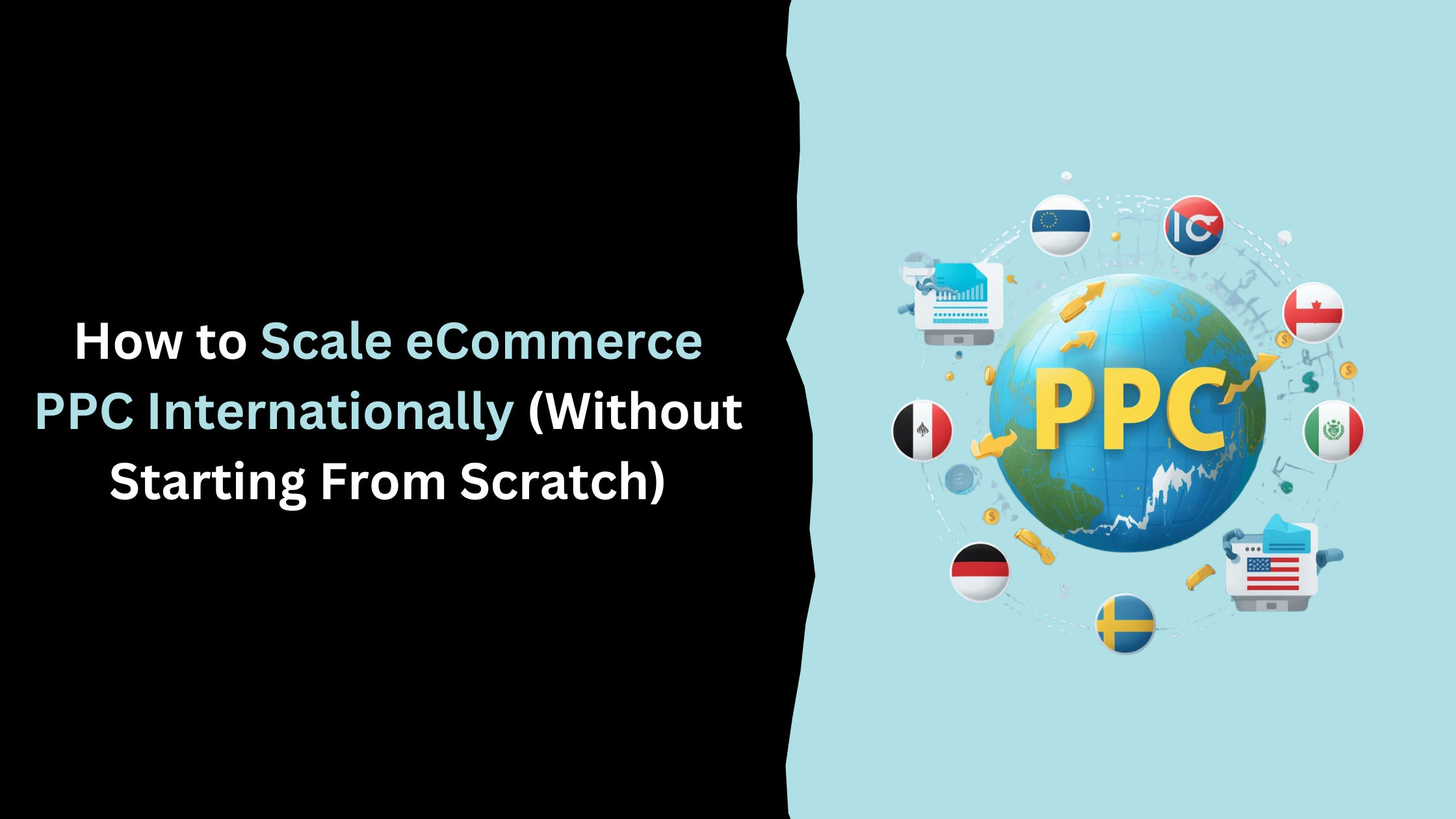
Scaling PPC into new countries is less about “launching more campaigns” and more about exporting proven signals from your home market into a new market wrapper (language, currency, shipping/tax reality, feed rules, and geo structure).
If you treat every new country like a blank slate, you’ll pay the learning tax repeatedly. If you treat it like a straight copy/paste, you’ll launch fast, but you’ll often leak spend because the non-obvious bits (feeds, shipping accuracy, location settings, and localisation depth) don’t match the new market.
This post is a practical playbook to expand internationally while reusing what already works, without inheriting the wrong assumptions.
The core idea: export signals, rebuild the wrapper
What already works in your home market is usually one of these:
- Winning product sets (categories/SKUs with strong margin + conversion rate)
- Winning intent clusters (themes behind top converting searches)
- Winning creatives (angles, proofs, offers, objections)
- Winning audiences (remarketing, customer lists, high-LTV segments)
- Winning landing page patterns (collection vs PDP, bundle pages, trust blocks)
What changes internationally is the wrapper around those signals:
- Local language and intent
- Local pricing psychology (currency, VAT expectations, shipping thresholds)
- Local shipping promise (cost + speed + delivery partners)
- Local tax and duties (what the shopper expects at checkout)
- Local Merchant Center/feed requirements (currency support, shipping config consistency)
Your goal is to keep the signal and update the wrapper.
1) Start with what already works (but package it correctly)
Before market selection, do a simple export of the “performance DNA” of your account. You’re trying to answer: what should we port first?
Build your “International Expansion Starter Pack”
Create one sheet or doc that includes:
A. Products to lead with
- Top 10–30 SKUs by profit (or contribution margin proxy)
- Top categories by ROAS stability (not best week ever - most repeatable)
- Items with low return rate and predictable shipping cost
B. Intent clusters that actually convert
Instead of “keywords,” capture themes:
- Brand terms (and brand+category combos)
- Competitor comparisons (if relevant)
- Category head terms vs long-tail modifiers
- Problem/solution terms (“X for Y”, “best Z for…”)
- High-intent qualifiers (size, material, compatible-with, replacement)
C. Offer + creative patterns
- What claims and proofs show up in your top ads?
- What trust cues appear on your best landing pages?
- Which promos lift AOV without killing margin?
D. Audience assets
- Past purchasers (split by recency and LTV bands)
- Cart/checkout abandoners
- CRM segments that correlate with conversion rate
This starter pack becomes your “don’t start from scratch” toolkit for every new country. You’ll still do market work, but you’re not reinventing what good looks like.
2) Market selection: pick countries you can actually win (and fulfil)
International PPC isn’t only a media problem. It’s an ops problem disguised as a media problem.
You can have perfect targeting and still fail because:
- shipping is too expensive,
- delivery is too slow,
- returns are a headache,
- your price looks wrong in local currency,
- or your feed is technically “live” but practically noncompetitive.
Use a Market Readiness Scorecard (quick + reliable)
Score each market 1–5 (5 = best). You only need ~6 criteria to make good decisions:
Only scale into markets where you can get to “operational truth” quickly: accurate shipping, accurate pricing, and a landing page that feels legitimate locally.
Sequence matters: expand by similarity first
To reduce the learning tax, expand first into markets that are operationally and linguistically close to your home market:
- Similar shipping lanes and delivery times
- Similar price points and buyer expectations
- Similar language variants (or at least fewer localisation layers)
Then expand into more complex markets once you’ve built the repeatable playbook.
3) Localisation: go beyond translation (but don’t overbuild too early)
“Localisation” is not a translation task; it’s a conversion task.
You’re trying to reduce the buyer’s “foreign brand risk”:
- “Is this legit?”
- “Will it ship to me?”
- “What will it cost in total?”
- “Can I return it easily?”
- “Will it arrive when I need it?”
The Localisation Stack (highest impact first)
1) Currency and price consistency
If you’re showing local traffic local ads, you generally want the entire purchase journey to feel local, especially currency. Merchant Center requires you to use a currency that’s supported for your target country.
(And in practice, currency mismatch is one of the fastest ways to destroy conversion rate.)
2) Shipping and returns clarity
Make shipping and returns obvious on:
- PDP above the fold (or near price)
- Cart page
- Checkout
Merchant Center shipping configuration is touchy: Google explicitly warns to keep account-level shipping settings consistent with item-level product data to avoid unexpected behaviour.
3) Message and terminology
Translate meaning, not words:
- Local words for the category (what shoppers actually type)
- Local sizing conventions, measurements, and abbreviations
- Local trust cues (delivery providers, payment methods, warranty phrasing)
4) Offer mechanics
Promos don’t always travel well:
- “Free shipping over X” thresholds need local math
- Percentage discounts may feel less compelling than fixed amounts (or vice versa)
- Local holiday calendars matter (but don’t force it - use what’s relevant)
5) Local proof
If you have reviews, UGC, or press that resonates in the new market, surface it early. If you don’t, lean into universal proof: guarantees, clear returns, and transparent delivery expectations.
4) Merchant Center and feeds: the part that decides if you can scale
International PPC gets blamed when conversion rate is low, but many “PPC problems” are actually feed + shipping accuracy problems.
Multi-country setup: one feed or many?
Merchant Center lets you show products in multiple target countries.
You can also add additional target countries to an existing product data source if the products are essentially the same and you don’t want separate data sources.
A practical way to decide:
Use one feed + add target countries when:
- Assortment is largely the same across countries
- Product titles/descriptions don’t need heavy localisation
- Pricing logic is consistent (or you can handle it with smart overrides)
- Shipping and returns are similar enough
Use separate feeds (or strong supplemental feeds) when:
- Assortment differs meaningfully by country
- Language needs true transcreation (not just translation)
- Pricing differs materially (currency + VAT + market pricing)
- Shipping/returns differ and must be messaged differently
Shipping configuration: the “make or break” gate
Google provides shipping settings in Merchant Center to specify costs, carriers, and delivery times.
You can set shipping account-wide, and you can override per item using the shipping attribute.
Two high-impact rules:
Rule 1: Keep shipping consistent across account-level and item-level data
Google warns that inconsistent shipping settings and item-level data can cause unexpected behavior, and that automated API updates (including via platforms like Shopify) can overwrite manual Merchant Center settings.
Rule 2: Shipping must match reality at checkout
Google can warn or suspend accounts for inaccurate shipping costs if the shipping rates in Merchant Centre are lower than what’s shown at checkout.
That’s why “international PPC” needs a feed-and-checkout alignment check before you push spend.
Pricing consistency matters too
Google also flags inconsistent pricing between Merchant Center and the site/checkout, and notes that fees included in base price must be reflected consistently on landing pages and at checkout.
Internationally, this shows up as:
- VAT inclusion differences
- duties/taxes surprises
- currency conversion rounding issues
- shipping fees applied later than expected
If customers feel “surprised” at checkout, ROAS will never stabilise, no matter how good your targeting is.
5) Location and language targeting: don’t let settings sabotage your tests
International targeting has two common failure modes:
- You accidentally show ads to the wrong people (waste).
- You over-restrict too early and never gather enough data (slow learning).
Location targeting: choose “presence” options intentionally
Google Ads has advanced location options that affect whether you reach people in a location vs people interested in a location.
This matters a lot for international expansion because “interest” targeting can pull in:
- travellers planning trips,
- expats,
- people researching the country from elsewhere,
- cross-border shoppers.
Depending on the business, that can be good or very noisy. The point is: don’t ignore it, make it a conscious choice per market and campaign objective.
Language targeting: helpful, but not a substitute for localisation
Google’s language targeting shows ads to users based on languages they use/understand on Google products and sites.
That means:
- It’s useful for controlling who can read your ads.
- It doesn’t guarantee a user is physically located where you think (that’s location settings).
- For multilingual countries, you often need a structured plan (separate campaigns or structured ad groups) rather than “one size fits all.”
6) Clone vs re-architecture: how to expand without copying your problems
You asked specifically about campaign cloning vs rebuilding. Here’s the decision logic that avoids the two extremes (“rebuild everything” vs “clone blindly”).
The simple decision framework
Clone when:
- The intent structure is universal (category demand behaves similarly)
- Your home structure is clean (logical segmentation, good negatives, stable tracking)
- Your top products and offers translate well
- You need speed and controlled learning
Re-architect when:
- The market searches differently (different modifiers, different decision logic)
- Product assortment differs
- Pricing and shipping force a different offer/positioning
- The language split is significant (e.g., multiple ad languages or dialect differences)
- Your home account structure is messy (cloning would duplicate chaos)
A tactical hybrid that works well: “Clone shell + rebuild the guts”
If you want speed without dragging every setting along, use Google Ads Editor.
Google Ads Editor supports:
- Copy (entire campaign and contents)
- Copy shell (campaign settings only)
And it explicitly notes that location targeting won’t be included when copying campaign settings.
A high-leverage approach:
- Copy shell to preserve naming, bidding framework, and baseline structure.
- Rebuild:
- keywords (local intent research + mapped from your clusters)
- ads (localised value props + local trust cues)
- location settings (set intentionally for the market)
- extensions/assets (shipping, returns, promo policy)
- keywords (local intent research + mapped from your clusters)
This is “not starting from scratch” without becoming “copy/paste and pray.”
7) Search vs Shopping/PMax: structure changes when feeds drive targeting
International Search expansion is mostly an intent-and-language problem.
International Shopping/PMax expansion is a feed and segmentation problem first, and a creative/localisation problem second.
Search expansion (practical approach)
- Start with your proven intent clusters.
- Build local keyword sets around:
- translated terms + local synonyms
- local spelling variants
- local units and sizing conventions
- translated terms + local synonyms
- Keep early structure simple:
- brand
- non-brand category themes
- top competitors (if you do it)
- brand
- Add negatives aggressively as you learn (especially for language bleed and research intent).
Shopping/PMax expansion (practical approach)
- Segment by:
- category margin bands,
- hero SKUs vs long tail,
- shipping feasibility (fast vs slow),
- price bands (if price sensitivity varies).
- category margin bands,
Then localise creative assets and landing pages per market.
The key: don’t try to scale Google Shopping/PMax internationally until the feed and shipping are correct and stable, because the system will “learn,” but it will learn on bad inputs.
8) Language/region testing: a clean matrix that teaches you what’s actually broken
When you enter a new market, performance can fail for different reasons:
- It’s the message (people don’t want what you’re saying)
- It’s the landing page (trust friction)
- It’s the offer (pricing/shipping)
- It’s the targeting (wrong users)
- It’s ops (you can’t deliver competitively)
A testing plan prevents you from guessing.
Build a simple 2–4 week testing matrix
Test variables
- Ad language
- Landing page language
- Offer framing (shipping threshold, guarantee, delivery claims)
- Location option (presence vs presence-or-interest depending on your model)
Example matrix
Run tests using Experiments (so you don’t pollute the account)
Google Ads supports experiment-style testing (A/B frameworks) in various campaign types; for example, Demand Gen has A/B experiments that can test creatives, audience, product feed, and bidding.
Even if you’re not using Demand Gen, the principle is the same: use controlled splits so you can attribute outcomes to changes instead of noise.
9) The scaling loop: how to grow internationally without losing efficiency
Once you have one market that’s working, don’t immediately open five more. Scale with a loop:
Step 1: Stabilise one country
You’re looking for:
- stable conversion tracking
- stable feed approvals and shipping accuracy
- stable CPA/ROAS ranges (not perfect - stable)
Step 2: Expand coverage inside that country
- Add more categories
- Add more long-tail intent clusters
- Expand creative variations
- Improve landing page localisation depth
Step 3: Only then, add the next country
Use the same gates:
- currency supported and consistent in feed + site
- shipping configuration consistent and accurate
- multi-country targeting correctly configured in Merchant Center if using shared feeds
This keeps expansion repeatable and prevents the “international sprawl” problem.
Common mistakes (and how to avoid them)
Mistake 1: Copying home-market campaigns and forgetting geo settings
If you use Editor “copy shell,” remember that location targeting won’t carry over automatically.
Fix: Build a geo checklist per campaign type.
Mistake 2: Running ads before shipping is consistent
Merchant Center warns about inconsistent shipping settings and item-level data.
Fix: Treat shipping configuration as a pre-launch gate.
Mistake 3: Shipping mismatch between Merchant Center and checkout
Google can warn/suspend for inaccurate shipping costs when Merchant Center shipping is lower than checkout shipping.
Fix: audit the full path - PDP → cart → checkout - on real country IP/VPN scenarios.
Mistake 4: Assuming “language targeting” solves localisation
Language targeting reaches users based on languages they use/understand; it doesn’t replace localisation work.
Fix: localise the offer and trust cues first, then refine targeting.
Pre-launch checklist (international PPC, no fluff)
Feed + Merchant Center
- Currency is supported for the target country
- If using one feed: additional target countries set correctly
- Shipping settings are consistent across account-level and item-level data
- Shipping costs match checkout (avoid “inaccurate shipping costs” issues)
Website
- Local currency is shown throughout the purchase journey
- Shipping/returns visible early (PDP + cart)
- Delivery expectation matches what you can actually do
Google Ads account
- Location targeting option chosen intentionally (presence vs broader options)
- Language targeting aligns with ad copy language
- Clone vs rebuild plan confirmed (Editor copy vs copy shell)
- Testing matrix and success metrics defined
Conclusion: the “don’t start from scratch” mindset
Scaling eCommerce PPC internationally isn’t about launching dozens of new campaigns. It’s about:
- exporting proven signals from your home market,
- rebuilding the wrapper that must change (language, currency, shipping/tax reality, feed structure),
- running controlled tests to learn what’s truly limiting performance,
- scaling one market at a time with the same gates.
Do that, and you get speed and compounding learnings, without paying the blank-slate tax every time.
Related Post

Get in touch today
complete the form below for an informal chat about your business

We are a small, but perfectly formed, Digital Marketing Agency based in Stoke-on-Trent, Staffordshire. We provide services that help business owners make more money online.

