


How a Specialist TV Bed Retailer Outranks Giants in Google's AI Mode | SearchUp
Search is changing. So are we.

Table of Contents
Something fundamental just shifted
At Google I/O 2026, Google described what it called the biggest upgrade to Search in over 25 years. Having watched the announcements closely, we think they are right.
Google has been moving towards AI-generated answers for a while now, but this year the shift moved from gradual to structural. AI Mode, AI Overviews, background information agents, conversational follow-ups within search, and a new universal shopping experience are not incremental updates. They represent a different model of how people find things online.
The old model was simple: rank high, get clicks. The new model is more complex, and in some ways more interesting: be cited, be trusted, be useful to an AI that is answering on your behalf.
The data tells the story
The traffic impact is already measurable, and the numbers are stark. According to SISTRIX analysis of over 100 million keywords, the click-through rate for a number one organic ranking, on queries where AI Overviews appear, has dropped from 27% to just 11%. A 59% collapse in the value of the top position.
Meanwhile, SparkToro and Datos data shows that more than half of all Google searches in the US now end without a single outbound click. The search is happening. The answer is being served. But the user is not coming through to your site the way they used to.
If your Google Search Console is showing impressions holding steady while clicks fall, this is why. Teams benchmarking against pre-AI traffic figures will misread the data and misallocate their budgets.
How people are searching is changing too
One of the most important shifts is not in how Google works, but in how users behave. People are increasingly typing the way they would ask a friend, not the way they would fill in a keyword box.
The old SEO terminology called these longer, more specific phrases 'long tail' keywords and often treated them as lower priority. In the AI era, they are where the real opportunity sits. Broad, high-volume terms are increasingly dominated by large retailers with enormous traffic advantages and marketing budgets to match. But a specific, conversational query? That is where a specialist brand with genuine expertise can appear right alongside the big players, or ahead of them, inside the AI-generated answer. People now search everywhere and this leads to direct clicks converting, attribution opacity and general dashboard meltdown.
Case study: TV Beds Northwest in Google's AI Mode
We want to illustrate this shift with a live example from one of our clients, TV Beds Northwest (tvbedsnorthwest.co.uk), a specialist TV bed retailer based in Bury, Greater Manchester.
The traffic gap, in real numbers
Using DataForSEO data pulled in May 2026, here is where TV Beds Northwest sits relative to its key competitors in UK organic search:
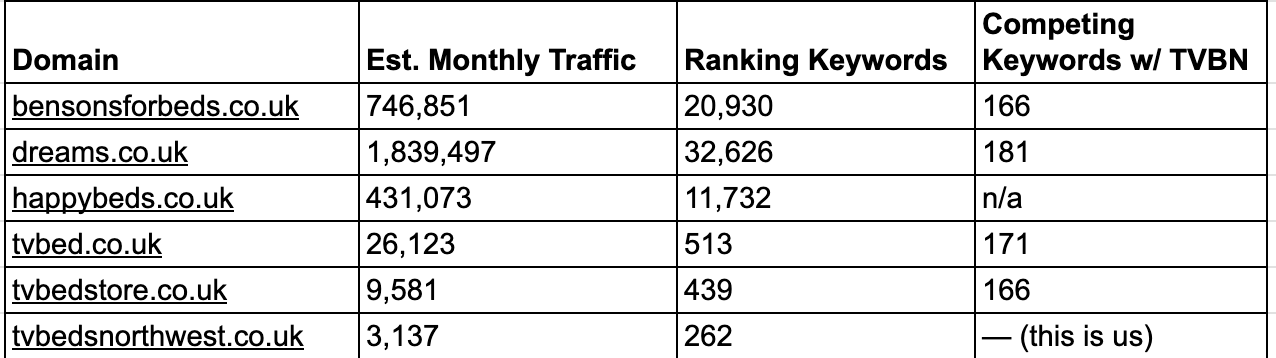
Source: DataForSEO Labs, May 2026. Traffic figures are estimated monthly organic visits (UK).
The traffic gap between TV Beds Northwest and its largest competitors is enormous. Bensons for Beds draws an estimated 747,000 organic visits per month. Dreams drew 1.84 million. TV Beds Northwest draws around 3,100. On the standard SERP, brand scale and domain authority are the dominant forces, and closing that gap through traditional SEO alone is a slow, resource-intensive process. The important caveat is that the top three competitors don’t just sell TV beds and the niche retailers have been trading for 10+ years, TV Beds Northwest, just three.
But something interesting happens when you move from the standard SERP into Google's AI Mode.
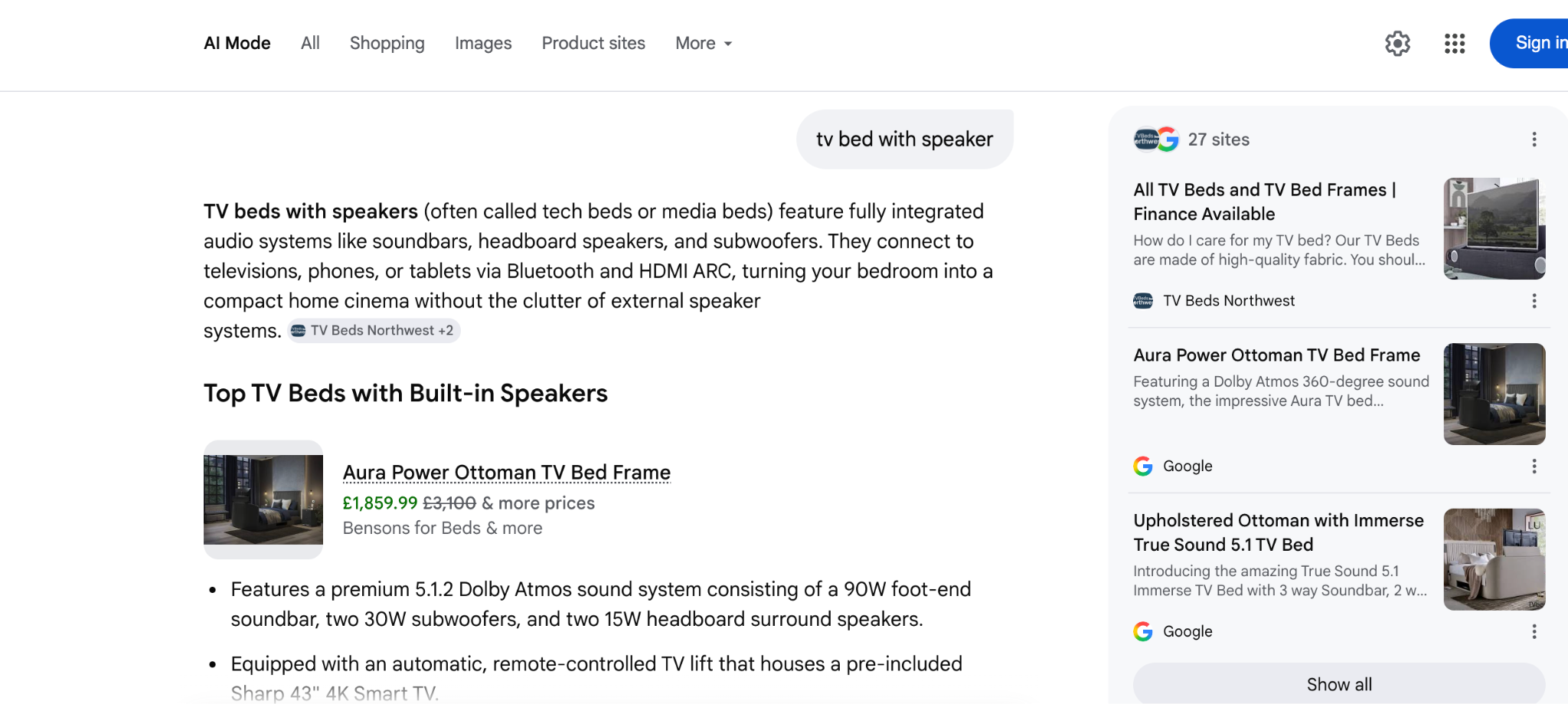
AI Mode, 'tv beds with speakers'
In this screenshot from May 2026, the standard Google results for 'tv beds with speakers' show exactly what the data would predict. The shopping carousel is filled with national retailers. The organic listings are led by TV Bed (tvbed.co.uk) and TV Beds Northwest, with larger brands further down. Domain authority and product feed quality carry the day. TV Beds Northwest is present, but competing on an uneven playing field.
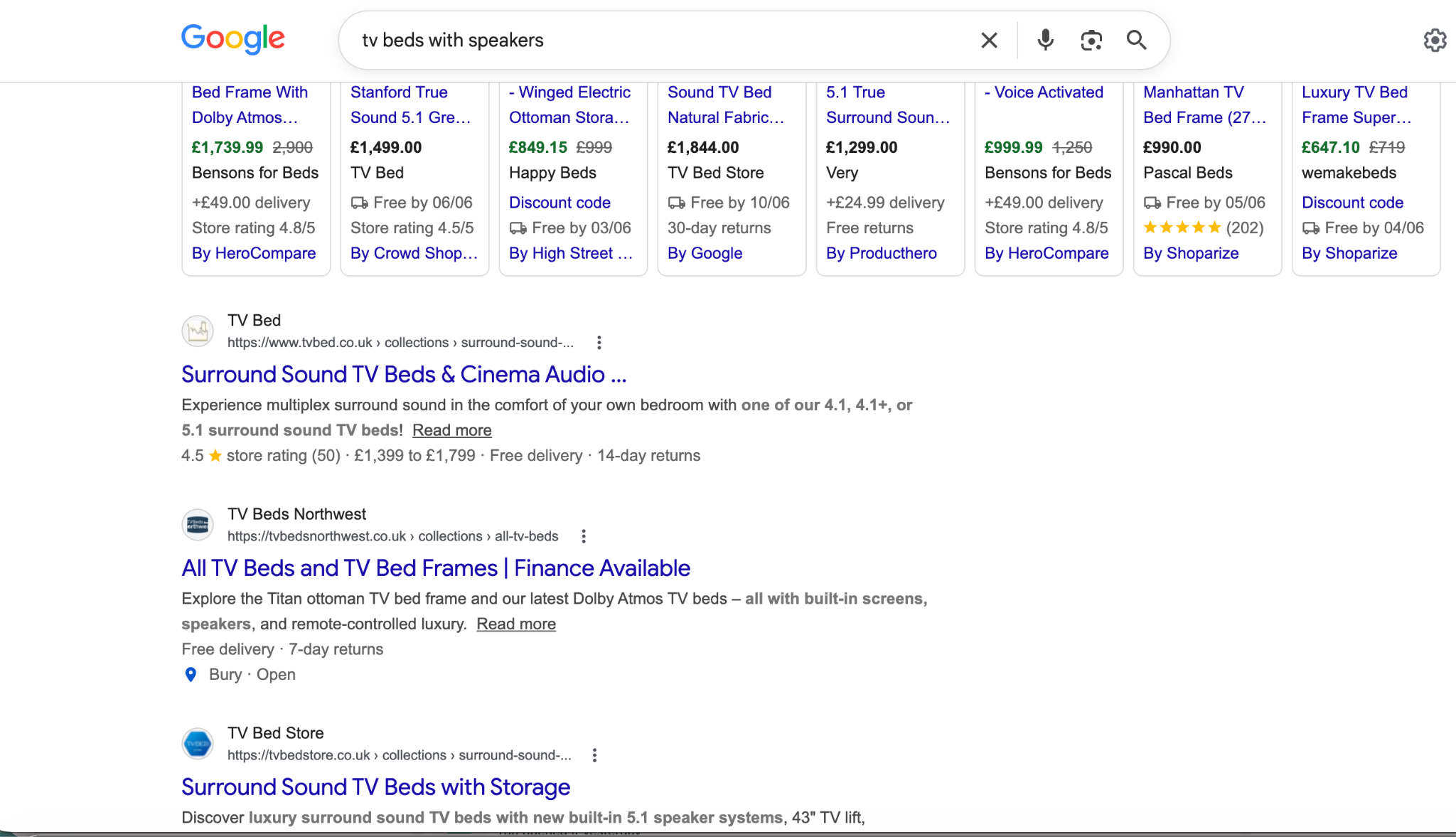
Standard mode, 'tv bed with speaker'
Switch to AI Mode with the same intent query and the dynamic changes. Google generates a detailed structured answer, and the source panel on the right lists 27 sites Google drew on for that response. TV Beds Northwest is among them, cited directly alongside the national retailers. The site with an estimated 3,100 monthly visits is in the same source panel as the site with 747,000.
This is not a ranking fluke. It is a structural feature of how AI Mode works. The AI is not ranking by brand size. It is citing by relevance and content quality.

AI Mode, 'What is the best tech bed in the UK right now?'
This query is as close to a buying decision as a search gets. The user is not browsing. They want a recommendation. In AI Mode, Google generates a direct answer and cites just 7 sources. TV Beds Northwest is one of those 7. The site with the smallest estimated traffic in the competitive set is being surfaced to a user at the highest point of purchase intent, alongside and in some cases ahead of competitors driving 100 times more organic traffic.
On the standard SERP, traffic volume and domain authority determine visibility. In AI Mode, content relevance and specificity determine who gets cited. TV Beds Northwest, with an estimated 3,137 monthly organic visits, is appearing in AI Mode source panels for high-intent queries alongside competitors drawing over 1.8 million monthly visits.
The gap has not closed in traditional SEO terms, and we are not pretending it has. But a new surface has opened where that gap is far less decisive, and TV Beds Northwest is already winning on it. The strategic question is how to build on that.
What SearchUp is doing about it
We have been tracking this shift closely and adapting how we work on behalf of our clients.
Monitoring AI Overview and AI Mode appearances
Our primary focus is tracking when and where our clients appear inside Google's AI Overviews and AI Mode responses. This is different to standard rank tracking. A brand can rank on page one and not be cited in the AI answer, and a brand can be cited in the AI answer without ranking at all in traditional results. We are building query sets that reflect real, conversational purchase behaviour, running them regularly, and recording citation appearances so we can measure progress and identify gaps.
Where a client is not being cited on queries they should own, we work back to understand why. Is the content too thin, too broad, or not structured clearly enough for the AI to extract from? Is a competitor being cited instead, and if so, what are they doing that we are not? This is the new technical SEO audit.
A proprietary tracking system in development
Standard rank tracking tools were built for a world of ten blue links. They are not designed to capture AI citation data at scale. So we have now developed our own proprietary system to track AI Overview and AI Mode appearances across large query sets, for multiple clients, consistently over time.
Our system allows us to report on GEO (Generative Engine Optimisation) performance with the same rigour we currently apply to traditional SEO metrics. Our existing clients will be the first to benefit from it, and we will share more detail as it develops.
We are reviewing client content with a focus on conversational query coverage: identifying the real questions buyers ask at each stage of the purchasing journey and ensuring those questions are answered clearly, specifically, and on the right pages. FAQ content, comparison content, and expert opinion content all perform well in AI citation contexts.
Structured data and crawlability
The AI draws on what it can read and understand. Structured data markup, clean site architecture, and well-organised product and category pages all make it easier for Google's systems to identify a brand as a relevant, trustworthy source. We are auditing this for all clients as part of our GEO readiness process.
This is not the end of SEO. It is the next chapter.
Traditional SEO fundamentals have not become irrelevant. Strong technical foundations, authoritative backlinks, and well-optimised pages still matter.
In fact, Google's own May 2026 guidance confirms that GEO is not a separate discipline from SEO. It is SEO applied to an AI surface, done well. The brands that win in the GEO era will be those with content no competitor can replicate, because it comes from genuine knowledge, real product experience, and an honest understanding of what their customers need. We're also clear eyed about the fact that many users won't search from Google's homepage - they'll type in directly from their browser, so we'll obviously be watching developments with interest.
That is exactly what we are helping our clients build. If you would like to talk through what this means for your business specifically, get in touch.
Related Post

Get in touch today
complete the form below for an informal chat about your business

We are a small, but perfectly formed, Digital Marketing Agency based in Stoke-on-Trent, Staffordshire. We provide services that help business owners make more money online.

