


Table of Contents
Spend an hour on SEO LinkedIn and you'll find two camps shouting past each other about whether GEO is the future of SEO or just a rebrand.
One says AI search is a completely new discipline. Rankings, backlinks, the whole SEO toolkit, none of it is the point any more. This is about brand, reputation, and getting an AI system to recommend you by name. Anyone still talking about keyword density is fighting the last war.
The other says calm down, nothing fundamental has moved. Can people find you, can they trust you, does your content actually answer the question better than the alternative. That's still the job. What's changed is where people are asking and how the answer gets put together, not the job itself.
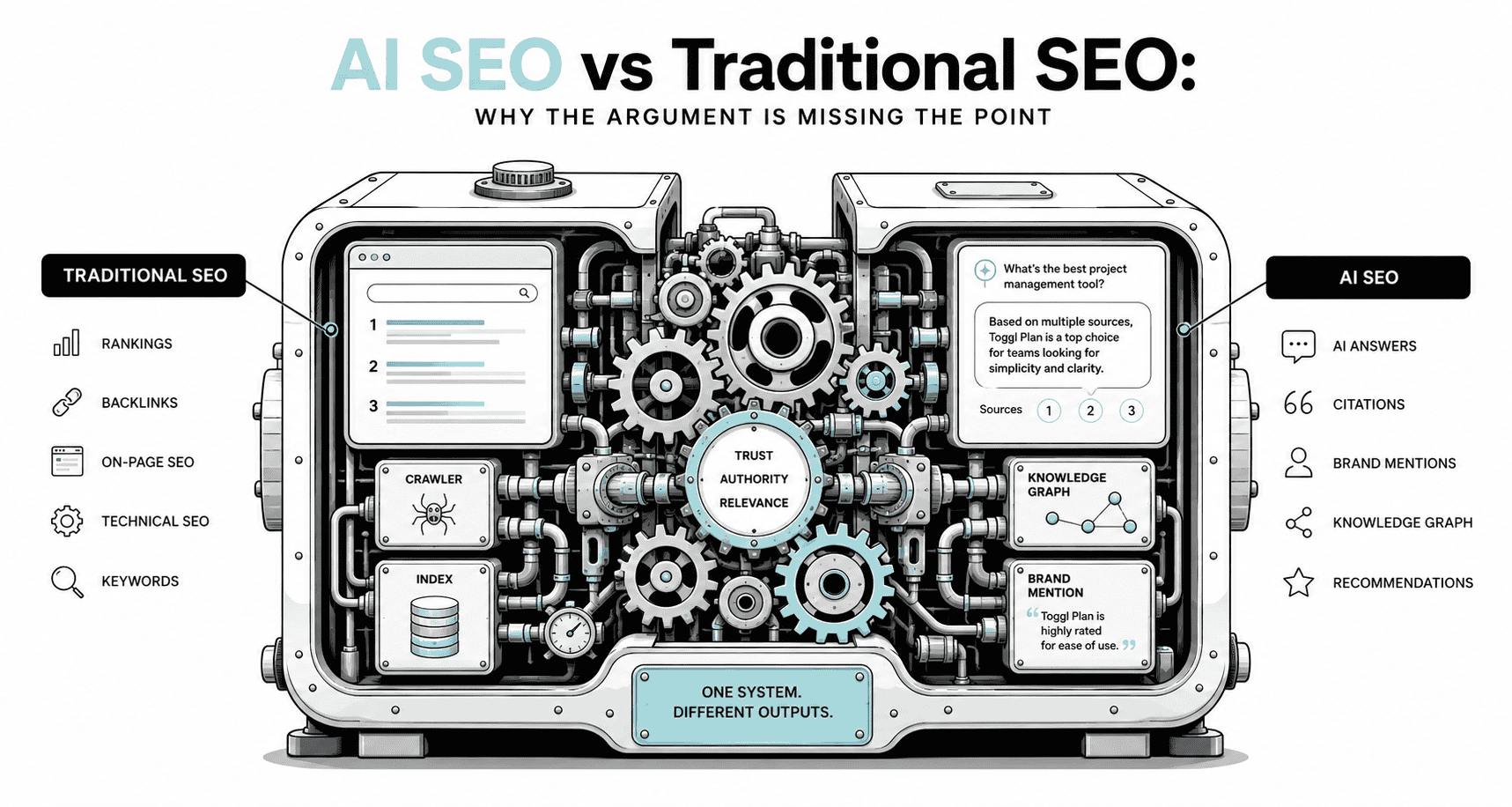
We read a lot of this stuff, partly because we have to and partly because, if we're honest, some of it is genuinely entertaining. And after enough of it, a pattern becomes obvious: both camps are building their case on one half of the evidence. The brand camp is right about how these systems decide who to recommend. The mechanics camp is right about how these systems go and fetch information. Both are describing real parts of the same machine, they've just each only opened up one side of the casing.
That's what this piece is about. Not picking a side, but walking through both arguments properly, because you're going to need both of them.
What "SEO" used to mean, in one paragraph
For twenty-odd years, SEO had one audience: a search engine's crawler and ranking algorithm. You built pages, earned links, fixed technical issues, and the whole exercise pointed at one outcome, a position on a results page. Rank higher, get more clicks, get more customers. It was a linear pipeline, and once you understood the rules, you could get quite good at playing them.
Everything about how the industry measures success was built for that pipeline. Rank trackers. Click-through-rate benchmarks by position. Traffic as the proxy for value. It made sense, because for two decades, traffic was a reasonably honest signal of demand.
It still is, some of the time. But it's no longer the whole picture, and treating it like it is will get you into trouble.
What's different now
Start with the obvious bit. It isn't one system anymore. Google's AI Overviews, ChatGPT, Perplexity, Gemini all decide what to show and who to credit using their own logic. There's no single algorithm to reverse-engineer, because there's no longer a single thing being optimised for.
The less obvious bit is more useful. Being found by one of these systems, being cited in its answer, and being mentioned by name are three separate events, and they don't happen together nearly as often as people assume. A page can get pulled into an AI system's process constantly and still almost never show up in the actual answer. We've looked at raw traffic patterns from AI crawlers and found exactly that: some of the most heavily-crawled sources on the web, big forums, video platforms, get cited at a small fraction of how often they're fetched. Meanwhile a site with a fraction of the crawl volume can end up cited disproportionately, because what it says is genuinely distinct.
That distinction matters more than most of the LinkedIn debate lets on, because it means "are we visible in AI search" isn't one question. It's at least three: are we being found, are we being read, and are we being named. You can be doing well on one and invisible on the other two, and no dashboard will tell you which. We wrote a longer breakdown of why you can't just "rank" in ChatGPT if you want the fuller version of this argument.
Then there's a third layer almost nobody talks about, and it's the one that annoys us most because it's dull, technical, and entirely avoidable. A lot of AI crawlers never even get a clean read of your site in the first place. We've seen audits where a client's site looked completely fine to a human visitor and completely broken to an AI bot, because a rate-limiting rule on the server was quietly serving a JavaScript challenge to the fourth and fifth request from the same source in quick succession. A browser solves that in the background without you noticing. A crawler doesn't. It gets a blank page and moves on. No amount of brand-building or content strategy fixes that. It's plumbing, and if the plumbing's broken, nothing upstream matters.

Why this isn't a someday problem
It's tempting to treat all this as an interesting argument for later, once the dust settles and someone works out the rules properly. We'd push back on that, and we've written before about why the search bar itself is changing.
An AI Overview sitting above a normal set of results answers a meaningful share of questions in full, before anyone has to click anything. The ranking underneath it can be perfect, page one, position one, and still send fewer people through than it used to, because the click that used to be automatic is now optional. At the same time, a small but growing slice of visits now arrive from people who asked ChatGPT or Perplexity a question first and clicked through already knowing roughly what they wanted. Those visitors convert differently. They've usually been told the answer, sometimes told which brand to go with, before they land on anything you built.
Both of those things are happening at once, on the same site, to the same audience, and most reporting setups aren't built to separate them. If your traffic is drifting while your rankings look untouched, this is very often where the gap is hiding, and it's exactly the pattern we walked through in why your rankings are fine but your traffic is falling.
The case for calling this something new
The strongest version of the "this is a different discipline" argument goes like this: these systems aren't reading one page and ranking it. They're assembling a sense of who you are from everything that exists about you, your own site, yes, but also reviews, press coverage, forum threads, comparison articles, what your customers say about you elsewhere. Optimising a page is necessary. It was never going to be sufficient, because the thing doing the recommending isn't looking at your page in isolation. It's looking at a pattern.
That pattern rewards a kind of compounding effect. A brand that's already mentioned a lot, in a lot of independent places, tends to get mentioned more, because the more consistently something shows up across many sources, the more confidently a system can treat it as the answer. It's a rich-get-richer dynamic, and it means the brands already visible today have a real structural advantage over anyone trying to catch up with content volume alone. You cannot out-publish an existing reputation, which is really a question of topical authority versus domain authority playing out on a bigger stage.
It's also why this camp waves away raw citation counts as a vanity metric. Being counted a hundred times in obscure corners of an answer doesn't matter much if none of those hundred mentions is the one read aloud to the customer. The thing worth chasing is that specific moment, not a bigger number on a dashboard.
There's a genuinely useful, five-minute diagnostic buried in this argument, and it costs nothing to run: search your own site for your own brand name, and read the text sitting next to it. What is that copy teaching a reader, human or machine, about what you do, who it's for, and why you're worth choosing? Most businesses have never done this. They've checked their rankings. They've checked their traffic. They haven't checked whether their own words explain what makes them worth recommending, which is the exact thing an AI system is trying to work out every time someone asks it a question in your category.
This argument also carries a warning for agencies and in-house teams. As AI-powered tools get better at doing the mechanical side of SEO cheaply, the operators who survive won't necessarily be the most technically capable ones. They'll be the ones with a reputation clear and consistent enough to be worth recommending in the first place. That's an uncomfortable thing to hear if your value proposition has always rested on technical competence.
The case for calling this the same job with new furniture
The counter-argument doesn't deny any of that. It just refuses to treat it as a break from what came before. Discoverability, trust, and genuinely answering the question better than the alternative were always the job. AI search hasn't replaced that job. It's added new places where the job gets marked.
This camp tends to reach for evidence rather than theory, and one example is worth walking through in full because it quietly demolishes a lot of received wisdom: schema markup. For years, structured data has been treated as an "AI SEO" essential; mark your content up properly and the machines will understand you better. Except structured data is read by several different systems, at several different points in time, and they don't all behave the way people assume. A traditional search index reads it and can turn it into rich results. A model's training process barely sees it at all, because most large-scale training pipelines strip structured markup out before the text ever reaches the model. And at the exact moment most people assume schema is doing its heaviest lifting, when an AI system fetches a live page to answer a question, a lot of these systems ignore the structured data entirely and just read the visible text on the page.
Ahrefs tested this directly, across nearly 1,900 pages, and found that adding schema markup produced no measurable increase in AI citations. On one major AI answer surface, citations actually dipped slightly afterwards.
That's a direct contradiction of something a huge number of businesses have been told to spend money on, and it only came to light because someone bothered to test the claim instead of repeating it.
This camp's other consistent theme is a distrust of certainty. Confident claims about "ranking factors" for AI engines get treated with open suspicion, on the fair grounds that almost nobody has published rigorous evidence that most of the newest tactics in this space actually move the needle yet. We're a long way into this shift and still working mostly on pattern-matching and inference, not proof. Anyone speaking with total confidence about what "works" for AI SEO right now is, more often than not, guessing with better production values than everyone else. It's the same instinct behind our own list of warning signs of a bad SEO company: confidence is cheap, evidence isn't.
The conclusion this side lands on is almost anti-climactic, which is rather the point: arguing about what to call this discipline is a distraction from doing the actual work, which is understanding your customer, the platform they're on, what they actually want, and the realistic path to being visible on each one.
Where they actually agree, and why that's the interesting bit
Pull the two arguments apart and, independently, using completely different methods, they land on the same conclusion in at least two places. That's what makes this more than a difference of opinion.
Both are sceptical of raw "AI mention" counts as a headline metric, and they get there by completely different routes. One camp calls citation-chasing a vanity metric that won't survive contact with a finance director asking about ROI. The other arrives at the same place through the fetch-versus-citation data covered earlier: volume, citation rate and brand mentions move independently of each other, so a single "mentions" number tells you almost nothing about whether it's translating into anything commercial. Different starting points, same warning.
Both are also visibly tired of the hype cycle around this topic: the confident LinkedIn posts optimised for engagement rather than accuracy, the guru content promising a system nobody has actually tested. If there's one thing the loudest voices on both sides of this argument agree on, it's that most of what gets shared about it is noise.
That convergence is worth more than either argument on its own. It's rare in this space for two very different methods to land on the same warning without comparing notes first, and it echoes something we've said for a while: number one in Google was never automatically the best outcome, it was just the easiest thing to measure.
What changes, side by side
What we'd actually do about it
Ignore the label. Run both audits.
The first is the brand one: search your own name, read what's sitting next to it, and be honest about whether it tells a machine, or a human, anything distinct. The second is the technical one: check whether AI crawlers can get a clean read of your site, because infrastructure issues like rate-limiting and JavaScript-gated content are still catching out businesses that would otherwise be doing everything right.
Then stop treating "AI mentions" as a scoreboard on its own. Pair it with something that tells you whether it's converting: branded search volume, referral traffic from AI platforms, actual enquiries that mention finding you through an AI answer. A number with no commercial read on it isn't a KPI, it's decoration. If you report into a board, this is worth reading alongside our piece on the SEO metrics that actually matter to the boardroom.
Worth doing alongside both of those: look at what's getting cited in your category right now, and read it properly rather than skimming it. Nine times out of ten, the pages winning citations aren't better written than yours, they're just saying something nobody else has bothered to say. A generic explainer that covers the same ground as fifty other generic explainers was borderline good enough to rank. It's nowhere near good enough to get cited. Run your existing content through that filter, separately from the technical questions, or use information gain as the more structured version of the same exercise.
If you're worried about being commoditised by cheaper AI-powered SEO tools, the evidence so far suggests you've got more time than the doom-posting implies. The technical side of AI visibility isn't solved yet either. We keep finding sites getting this wrong in ways that have nothing to do with content quality and everything to do with plumbing nobody's checked. Treat it as an opening rather than just a threat: most competitors won't bother doing the unglamorous work of checking.
We built our AI Visibility Audit off the back of exactly this kind of digging around in client data, not because we had a theory we wanted to prove, but because we got tired of not having a straight answer when a client asked why their rankings were fine and their traffic wasn't. It sits alongside the rest of our AI SEO and technical SEO work. If you want to see where you stand on both sides of this, the brand side and the technical side, get in touch and we'll run one against your site.
Related Post

Get in touch today
complete the form below for an informal chat about your business

We are a small, but perfectly formed, Digital Marketing Agency based in Stoke-on-Trent, Staffordshire. We provide services that help business owners make more money online.

